

Most creators pick topics from gut feeling, post, and pray for the algorithm to deliver traffic. There's a more reliable approach: see what users are actually searching for, find questions no one has answered well, and write precisely for that — search traffic comes to you.
Xiaohongshu (RedNote) is becoming a search engine. More and more users go straight to the search bar when they need product recommendations, how-to guides, travel tips, or honest reviews. Where the content is, that's where people search.
Every search query on Xiaohongshu has a real person behind it — someone with a specific need. If your content happens to be the best answer to that need, the search traffic is yours.
That's the core logic behind Xiaohongshu keyword research: instead of chasing viral hits, systematically target long-tail keywords so each post captures a precise slice of search demand.
"I'm Not Chasing Virality — I'm Claiming Search Territory"
A user running a tourism marketing project shared her content strategy: "The way I think about these posts — they're for claiming search keywords. I'm not expecting any single post to go viral, but I can win through volume."
Most content creators are chasing the hit — 100K likes, going viral, rapid follower growth. Her approach is fundamentally different.
For her Yunnan tourism project, she doesn't just target broad keywords like "Yunnan travel guide." Instead, she checks what users are actually typing into the search bar:
- Tiger Leaping Gorge hiking
- Lijiang outfit ideas April
- Is Shangri-La worth visiting
- Living in Dali for a month
- Tengchong wellness retreat
Each search query represents a specific person with a specific need. No single post needs to go viral — as long as each one precisely matches a search query and the posts keep coming, the search traffic stays steady.
The Blind Spot Most Creators Have
Many content creators operate under a default assumption: what I think is important must be what my audience thinks is important too.
The books you've read, the skills you've built, the frameworks you've internalized — these shape what you think a post "should" cover. But users don't search based on your knowledge structure.
When someone opens the Xiaohongshu search bar, they're not thinking in frameworks. They're in a specific situation.
She's a new mom at 3 AM looking for time management advice. He's an office worker who can't sleep because of quarterly OKRs. She's a grad school applicant whose hands shake from anxiety.
They don't search for "5 principles of time management." They search for "how do new moms organize their day." They're looking for someone like them — how that person got through it, what they did, what tools they used.
That's why the first step of Xiaohongshu keyword research isn't brainstorming topics. It's going to the search bar and seeing what users are actually searching for.
A 5-Step Xiaohongshu Keyword Research Process
This can be broken down into a repeatable workflow.
Step 1: Search Your Core Term and Read the Suggestions
Go to the Xiaohongshu search bar. Type in your niche's core keyword, but don't press Enter — just read the autocomplete suggestions that appear.
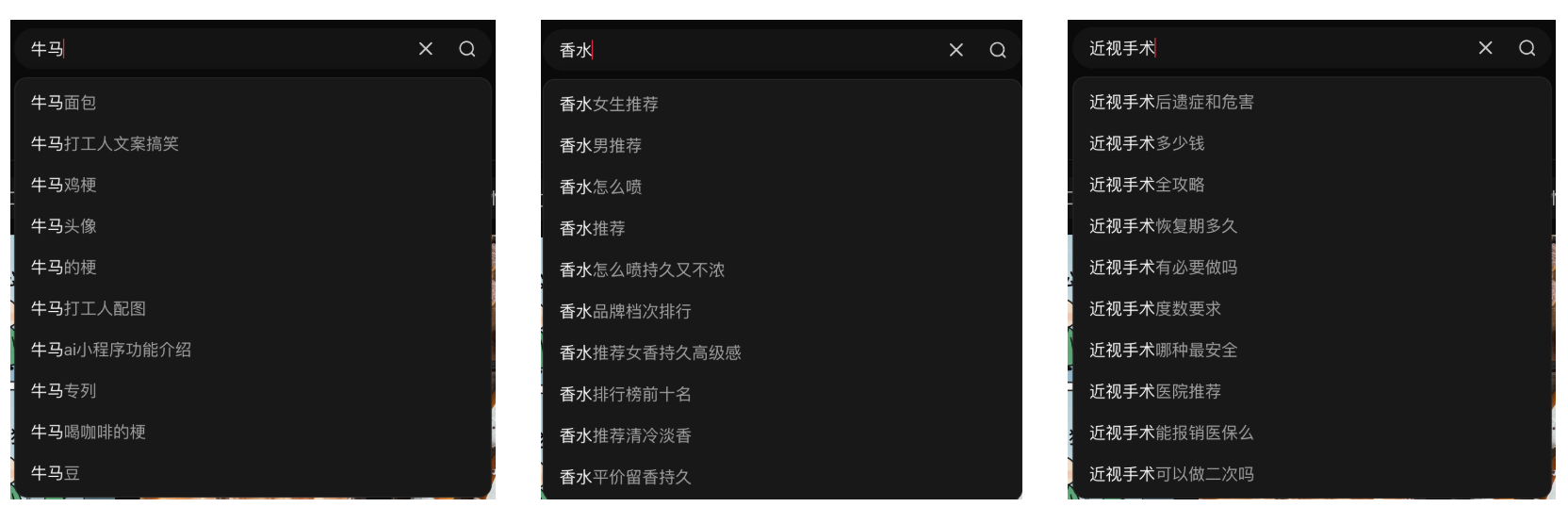
These suggestions aren't random. They reflect what real users search for most frequently. You'll almost certainly discover queries you never considered — real demand you didn't know existed.
Step 2: A-Z Expansion — Uncover Every Long-Tail Keyword
The default suggestions only scratch the surface. After your core keyword, add a space, then type each letter from a to z (and digits 0–9), reading the suggestions each time.
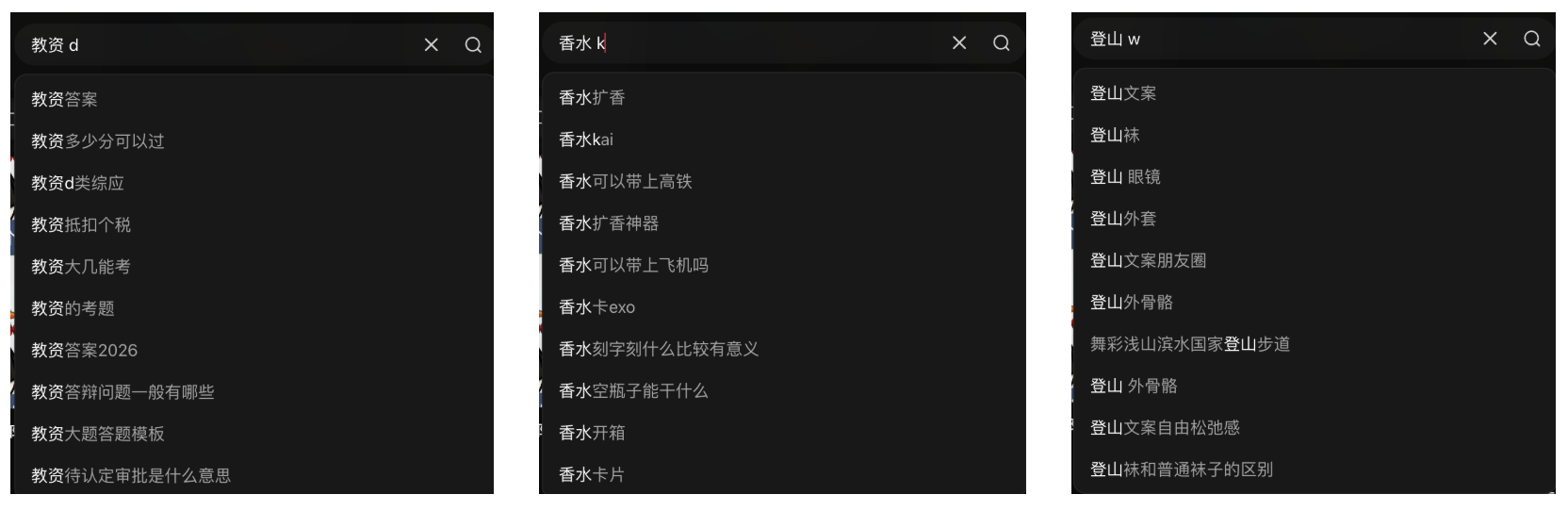
For example: "skincare routine a", "skincare routine b", and so on. Some suggestions will surprise you — queries you've never heard of, but the platform is telling you people are actively searching for them. A single seed keyword can expand into dozens or even hundreds of long-tail keywords.
Step 3: Check the Top Results — Evaluate Content Quality
Pick a few interesting keywords, search for them, and review the top 10 posts. Look for these signals:
- Do the top-ranking posts actually answer the user's question?
- Are they well-crafted or low-effort? How's the engagement?
- What are users asking about in the comments? What are they complaining about?
Many people stop at finding keywords and start writing immediately. But the keyword is just an entry point — the quality of existing content determines whether there's an opportunity.
Step 4: Classify by Competition — Find the Content Gaps
The keywords you find will generally fall into three categories:
| Category | What You'll See | Strategy |
|---|---|---|
| High demand, strong content | Top posts are high-quality with good engagement | Competitive — save for later |
| High demand, weak content | Users are searching, but nobody's answering well | Biggest opportunity — prioritize this |
| High demand, near-zero content | Very few search results | Proceed with caution — could be a blue ocean or a topic the platform doesn't promote |
The second category offers the best return on effort. Users are searching, nobody's writing well — you step in, and the search traffic is yours.
Step 5: Focus on the User's Real Need, Not Keyword Stuffing
Once you've chosen a keyword, don't jump straight into outlining. First ask: What problem is the person searching this keyword actually trying to solve?
The search query is the entry point; the underlying need is the anchor for your content. Write around the need, not around cramming in keywords — that's the difference between content SEO and spam SEO.
Try This Manually for a Week and You'll See the Problem
The process is logical, but do it manually for a week and you'll hit a wall: Xiaohongshu has one set of suggestions, Douyin (TikTok China) has another, running through every letter takes time, and search trends shift constantly.
We built this capability into MediaClaw's Keyword Intelligence feature:
Enter a seed keyword — say, "skincare routine" or "home decor" or "IELTS prep" — and the tool automatically runs through all autocomplete suggestions, deduplicates, and uses AI to cluster them by user intent.

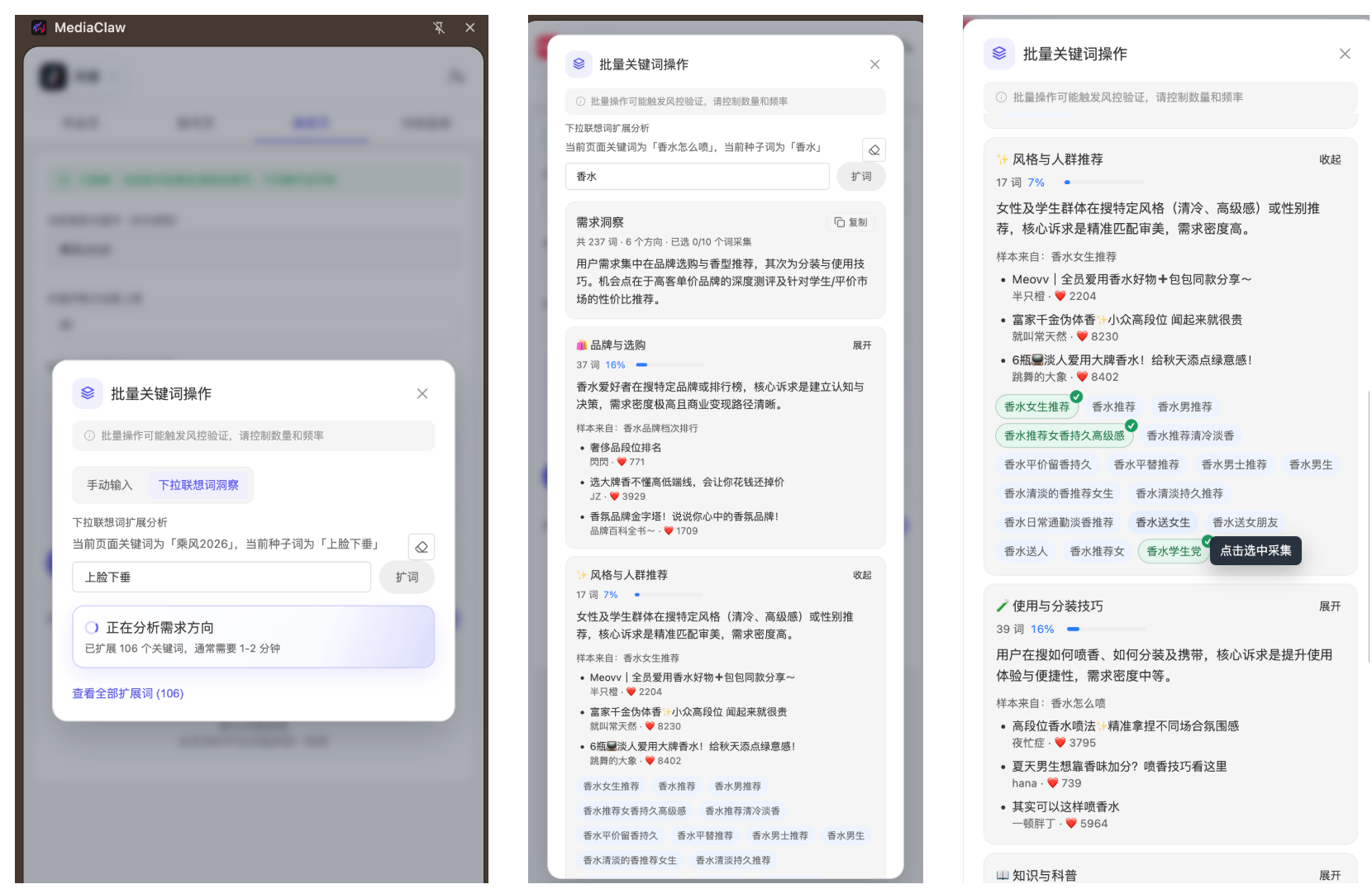
What you get is a user demand map — effectively a content planning guide. Every long-tail keyword is a topic with a built-in, intent-matched audience.
Lottery vs. Farming
Most creators default to this mode: think of a topic → write a post → publish → pray the algorithm delivers traffic.
A more reliable approach: see what users are searching → find needs no one has answered well → write a targeted post → search traffic comes to you.
One is a lottery. The other is farming. Farming isn't glamorous, but the harvest is predictable.
Run through this process once and you'll realize: you might have 10–20 topic ideas in your head, but users are actively searching for hundreds of keywords. Keywords generate more keywords, and you'll never run out of topics. Search traffic doesn't get throttled — it compounds over time.
Install MediaClaw, enter a seed keyword for your niche, and get a complete set of expanded search suggestions with AI demand analysis in 2 minutes.


