

This 5-step framework shows you how to build a Xiaohongshu content idea bank grounded in real user search behavior — one that grows over time instead of running dry.
Most creators' "topic lists" are really just inspiration dumps: spot a competitor's viral post, jot it down; see a trending hashtag, add it to the list. The problem? Inspiration is finite. Once you've used up your list, you're back to mindlessly scrolling Xiaohongshu (RedNote) hoping something sparks.
A content idea bank that actually sustains consistent publishing needs to be built on real user demand. Every query typed into the search bar, every question in the comments — these are explicit content requests. Collect and organize them systematically, and your content calendar stops being "whatever I stumble on" and starts being "exactly what users are looking for."
Here's a proven 5-step process to build a data-driven content idea bank from scratch.
Step 1: Define Your Niche Seed Keywords
Seed keywords are the foundation of your entire idea bank — typically the 1–3 most fundamental terms in your niche.
How to pick them:
- Choose broad niche terms you consistently create content around — e.g., "skincare routine," "home organization," "side hustle"
- Keep them short: 2–3 words that define your space
- 1–3 seeds is plenty — each one will expand into hundreds of long-tail keywords
For example: if you create home content, your seeds might be "home organization," "home decor," or "small apartment." For career content: "side hustle," "resume tips," or "job interview."
Watch out: Don't pick overly broad terms ("weight loss," "make money") — the search results are too noisy. And don't pick ultra-specific long-tail phrases ("fall commute outfits for women in their 30s") — there's no room to expand. Aim for the middle ground.
Step 2: Expand 1 Keyword into 200+ Long-Tail Ideas with Autocomplete Mining
With your seed keywords ready, the next step is to uncover every related search query users are actually typing.
You might have tried the manual approach: type a seed keyword into Xiaohongshu's search bar, then append each letter a through z to see what autocomplete suggests. It works, but a single pass takes at least 30 minutes and you'll inevitably miss things.
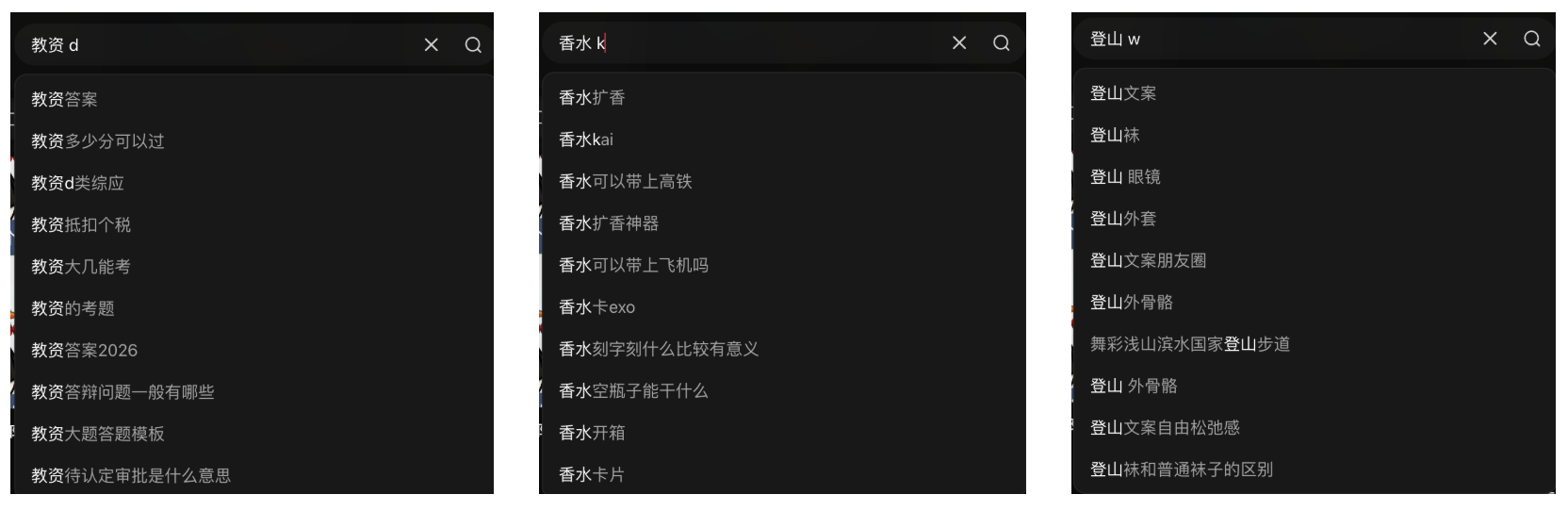
MediaClaw's keyword expansion feature automates this entire process: enter a seed keyword, and the tool appends each letter a–z, batch-collects every autocomplete suggestion the platform returns, deduplicates, and delivers a complete keyword list. A single seed typically expands into 200+ long-tail keywords.
This feature is free with unlimited use. Here's how:
- Open Xiaohongshu in your browser with the MediaClaw extension installed
- Navigate to the Keywords page
- Enter your seed keyword and click Expand in the extension panel
- Wait 1–2 minutes for the full keyword list to generate
- Copy or share the results with your content team
You'll end up with a 200+ keyword list. Every single entry reflects a real user search intent — each one is a natural content idea.
Step 3: AI Clustering — Turn Raw Keywords into Content Themes
200 keywords spread across a spreadsheet are still just noise if you don't organize them. The goal here is to cluster those scattered long-tail terms into 6–10 clear content themes.
You could do this manually, but it's time-consuming and easy to miss hidden patterns. MediaClaw's AI Insights feature automatically clusters all expanded keywords by user intent into 6–10 thematic groups, generating a brief for each theme with 15–20 recommended high-value keywords.
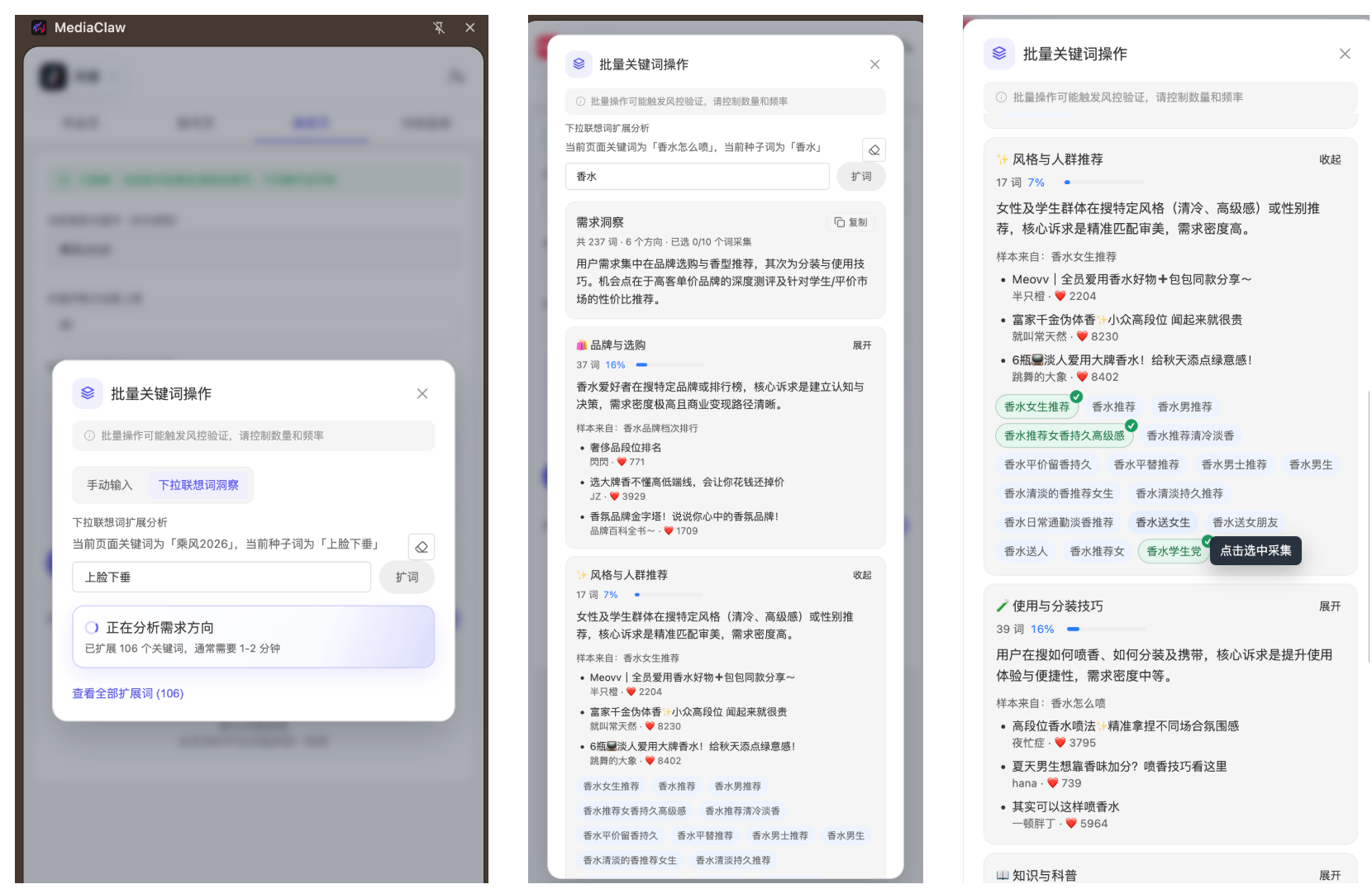
For example, expanding the seed keyword "home organization" might produce clusters like:
| Content Theme | Example Keywords | Content Opportunity |
|---|---|---|
| By room type | small apartment organization, kitchen storage, rental organization | Room-by-room content series |
| Product reviews | storage bins review, best organizers | Product recommendation posts |
| How-to guides | closet organization methods, decluttering tips | Tutorial-style posts |
| By audience | dorm room storage, organizing with kids, renter-friendly solutions | Audience-specific content |
Each theme contains a dozen or more specific topics to write about. A single seed keyword can fuel 2–3 months of content.
Step 4: Validate Low-Competition Keywords — Find What's Worth Writing First
AI clustering gives you direction, but not every keyword deserves immediate attention. Among 200 keywords, some already have strong content from established creators, while others have barely been covered — the latter are your low-competition opportunities.
Pick 3–5 keywords from each theme that look promising, search for them on Xiaohongshu, and check three things:
- Engagement on top posts: If the top 10 results all have fewer than 1,000 likes (adjust this threshold for your niche), the keyword isn't dominated by big accounts yet — competition is low
- Small accounts with strong engagement: If you spot posts from creators with under 5,000 followers getting 500+ likes, it means the platform is willing to push traffic to this topic — new accounts have a real shot
- Timing of top content: Look at when the best-performing posts were published. If recent posts (within the past week) are getting solid engagement, the keyword is trending upward — a rising opportunity. If all the high-engagement content is from six months ago with nothing new, the topic may have peaked — lower your priority
MediaClaw's search results scraping feature speeds this up: search a keyword and export the engagement metrics and follower counts from the results page in one click. Enable "Enhanced Scraping" for follower data, then sort by follower count — low-competition keywords become obvious at a glance.
Step 5: Refresh Regularly to Keep Your Idea Bank Current
A content idea bank isn't a one-time build. Platform trends shift, user needs evolve, and last month's untapped keyword might already be saturated.
Recommended cadence:
- Weekly: Re-run keyword expansion with the same seed keywords and compare against last week's results. New autocomplete suggestions often signal fresh traffic opportunities — validate them using Step 4
- Monthly: Add 1–2 new seed keywords to expand your content territory
Stick to this rhythm, and your idea bank grows thicker over time instead of thinner.
Takeaway
Building a Xiaohongshu content idea bank comes down to one shift: moving from inspiration-driven to data-driven. Use keyword expansion to surface real user search demand, use AI clustering to reveal content themes, and drastically cut the time spent hunting for low-competition topics. No coding required.
Try it now with a seed keyword from your niche. One expansion takes 5 minutes — and you'll realize you have more content ideas than you could ever run out of.
Download MediaClaw free and start building your content idea bank →


