

Keyword placement isn't just about the title. Your profile, cover image, caption, hashtags, and comments — each spot plays a different role. Place keywords in the right locations, and search traffic will find your notes.
Most creators think keyword optimization means stuffing keywords into the title. The title matters, but it's only one piece of the puzzle. Xiaohongshu's (RedNote) official keyword placement framework breaks it down into four layers:
- Profile layer: Include core keywords in your username to strengthen your account positioning
- Visual layer: Place keywords in cover text and in-image text so the algorithm connects your keywords with your visuals
- Content layer: Incorporate keywords naturally into your title and caption to match search intent
- Distribution layer: Use hashtags and comments to expand your reach across more search queries
These four layers work together — from long-term positioning down to post-level traffic amplification — to form a complete keyword placement system. Let's break down each one.

Profile Layer: Your Username Is a Permanent Keyword
Many creators overlook this: your username is one of the highest-authority keyword positions on the platform. When users search for a category term, accounts with that keyword in their name appear in the "Users" section of search results.
Say you create baby food content and your username is "FishMom." People searching for "baby food recipes" won't find you. But if you change it to "FishMom | Baby Food Recipes," your account gains an extra discovery path.
Two principles for choosing username keywords:
- Pick broad category terms, not ultra-specific long-tail keywords. Your username is a long-term positioning tool, not a single-post optimization
- Keep it readable. Don't turn your name into a keyword string. A natural-sounding name is easier to remember
The same applies to your bio. Use one sentence to describe what you do, with your core category keyword naturally included — this helps the algorithm tag your account accurately.
Visual Layer: Text in Images Gets Indexed Too
Xiaohongshu is a visual-first platform — users see the cover image before the title. What many people don't realize is that text on cover images and text embedded in photos also gets recognized and indexed by the algorithm.
This means your cover isn't just an attention-grabber — it's also a keyword carrier.
How to Place Keywords in Cover Text
Most covers include a bold headline. That headline needs to do two things: make people want to tap, and give the algorithm a keyword signal.
For example, if you're sharing an air fryer recipe, a cover that says "So Delicious!" — people get it, but the algorithm can't extract any category information. Change it to "Air Fryer Egg Tarts | Foolproof Recipe" and you have keywords plus click appeal.
In-Image Text Matters
Beyond the cover, any text within your post images — tutorial steps, product comparisons, ingredient lists — gets picked up by OCR. You don't need to force keywords into every image, but including core terms in the text of key images gives your search ranking a positive boost.
Content Layer: Title and Caption Are the Foundation
The content layer is where most creators focus their keyword efforts — and for good reason. This is where search weight is most concentrated.
Title: Front-Load Your Core Keywords
Xiaohongshu's search results page truncates titles, usually showing only the first half. The algorithm also assigns higher weight to keywords that appear earlier in the title. These two facts lead to one conclusion: put your most important keyword at the very beginning of the title.
A simple formula for title structure: Core keyword + Result/Value + Emotional hook. The front half serves the algorithm; the back half serves the reader.
| Before | After |
|---|---|
| Sharing a yummy dessert recipe | Air Fryer Egg Tarts: Foolproof Recipe Even Beginners Can Nail |
| This lipstick is so pretty | Best Lipstick for Warm Skin Tones — Looks Amazing Without Makeup |
| A great way to memorize vocabulary | Fastest Way to Memorize Vocabulary: 200 Words a Day That Actually Stick |
The "before" titles read like casual social posts. The "after" titles front-load keywords for the algorithm while keeping the human appeal in the second half.
One detail: keywords in the title should appear as a complete phrase, not broken apart. "Air fryer egg tarts" matches user search queries more precisely than "egg tarts made with an air fryer" because the former is an exact match.
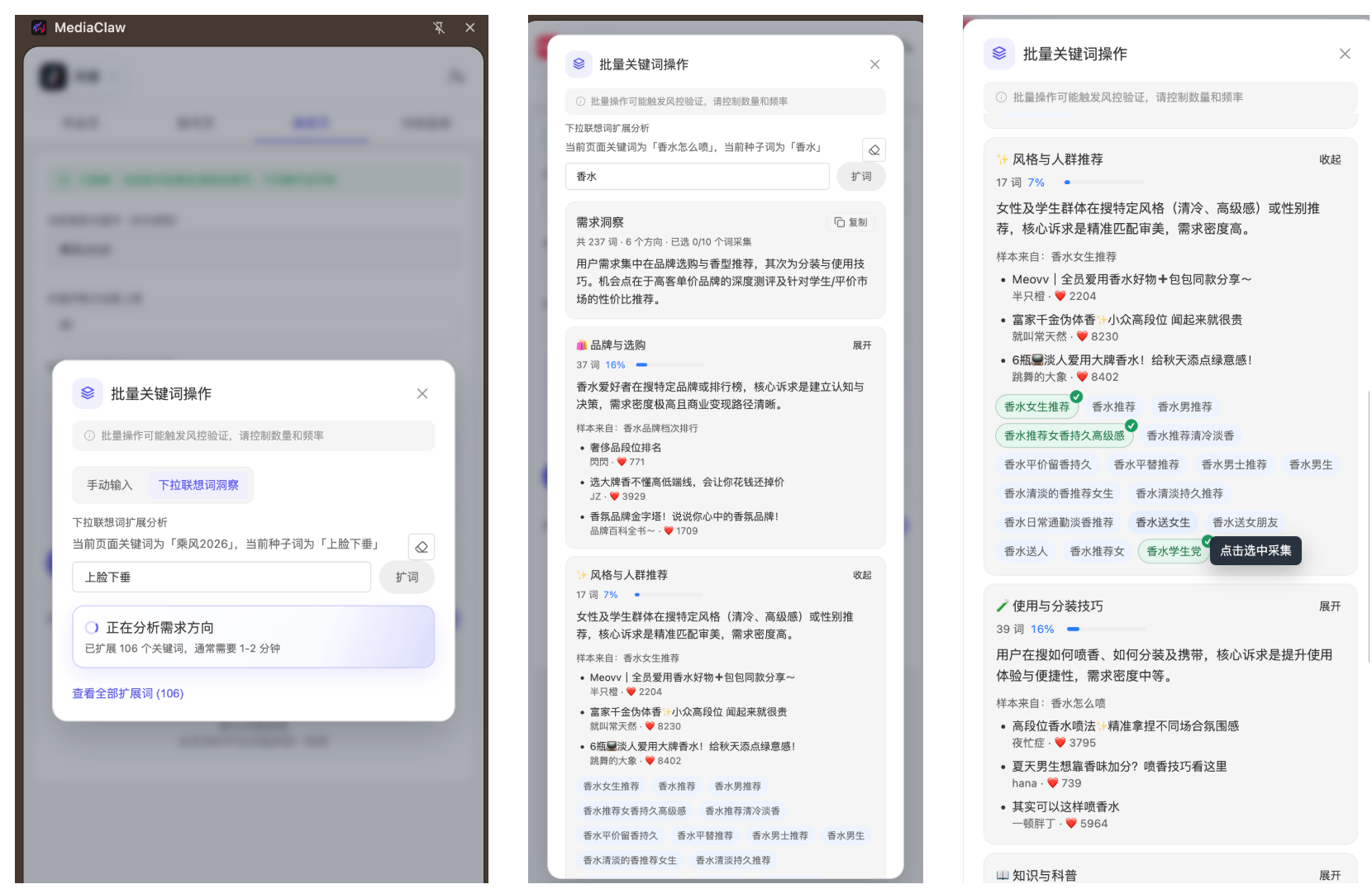
How do you find keywords worth ranking for? Don't guess — use data. The Xiaohongshu keyword research tool shows search volume and competition level for each keyword, helping you find high-volume terms that aren't oversaturated yet.
Opening Lines: Help the Algorithm Lock In Your Topic
The title tells the algorithm what your note is roughly about; the opening paragraph confirms it. The algorithm assigns higher weight to the first paragraph than to later ones.
The move is simple: include your core keyword again in the first sentence and get straight to the point.
For example, if your title is "Air Fryer Egg Tarts: Foolproof Recipe," your opening could be: "I've tested dozens of air fryer egg tart recipes — this version finally nailed it on the fourth try." The keyword appears naturally while delivering useful context to the reader.
Many creators start with "Hey everyone! Today I want to share something amazing!" The algorithm reads that sentence and gets zero topic information. You've just wasted the second-highest-weight position in your entire post.
Body Text: Incorporate Naturally, Don't Stuff
Keywords in the body text reinforce your relevance signal, but the weight here is already third in priority — no need to overdo it. Including your core keyword 2–3 times in the body is enough, woven into scenario descriptions and how-to steps.
What does natural incorporation look like? Mentioning "the key to air fryer egg tarts is keeping the temperature under 180°C" — the keyword appears within a meaningful context.
What does stuffing look like? "Air fryer egg tarts are delicious. Air fryer egg tarts are easy to make. Air fryer egg tarts only take three steps." This reads like a broken record and may trigger the platform's anti-spam system, resulting in reduced visibility.
Beyond your core keyword, weave in semantically related terms throughout the body. When writing about air fryer egg tarts, naturally mentioning "custard ratio," "baking time," and "pastry texture" helps the algorithm better understand your content's scope.
Want to see what keywords top-performing notes in your niche are using? The Xiaohongshu note scraper lets you batch-collect titles and captions from competitors, extracting high-frequency keywords and related terms far more efficiently than manually browsing.

Distribution Layer: Hashtags and Comments Amplify Your Reach
The distribution layer doesn't directly boost your search ranking — instead, it widens your exposure footprint, giving your note a chance to appear in results for more related search queries.
Hashtags: Use a Layered Strategy for Broader Coverage
Xiaohongshu's recommended hashtag strategy combines broad topic hashtags + long-tail hashtags:
- Broad topic hashtags: Tap into larger traffic pools, e.g., #AirFryer #Baking
- Long-tail hashtags: Reach targeted niche audiences, e.g., #AirFryerEggTarts #BeginnerBakingTips
A practical structure to follow is 2-3-3:
- 2 high-traffic hashtags: broad category terms like "food" or "air fryer"
- 3 mid-traffic hashtags: sub-category terms like "baking," "afternoon tea recipes," "easy desserts"
- 3 precise long-tail hashtags: closely tied to your specific content, like "air fryer egg tarts" or "beginner baking tips"
High-traffic hashtags ride the category wave; long-tail hashtags reach users with specific intent. Covering both ends outperforms going all-broad or all-niche.
More hashtags isn't always better. Beyond 10, the weight assigned to each individual hashtag gets diluted further. Around 8 is the sweet spot.
Comments: The Overlooked Keyword Boost
Many creators don't realize that comment text also gets indexed by the algorithm. This makes the comment section another spot where you can place keywords.
Here's how:
- Leave a comment right after publishing: Drop 1–2 comments on your own note, naturally including your core keyword or related long-tail terms. For an egg tart tutorial, you might comment: "Someone asked about the custard ratio — I use a 1:1 mix of heavy cream and milk"
- Prompt discussion: End your note with a question related to your keyword to encourage readers to comment. If their replies naturally include relevant terms, they're effectively adding keyword signals for you
- Include keywords when replying: When responding to reader questions, weave in your core keyword naturally — not forced, just within the context of your answer
Comments carry less weight than the title or body text, but they have one unique advantage: they can be updated continuously. You can keep adding new keywords through comments long after publishing, effectively extending the search life of older notes.
Want to see what competitors' comment sections are discussing? The Xiaohongshu comment scraper lets you batch-collect comments from target notes, analyze high-frequency terms and user pain points — those terms are exactly what you can add to your own comment section.

Advanced: Triggering Both Search and Recommendations
Everything above addresses search traffic — users actively searching a keyword and finding your note. But roughly half of Xiaohongshu's traffic comes from recommendations — the Explore feed on the home screen. A well-optimized note can capture both.
The trick is to add an emotional hook on top of your search keywords.
For example, "Round Face Daily Makeup Tutorial" has solid keyword placement for search, but nobody's tapping that in the Explore feed — it's too flat. Change it to "Someone Asked If I Lost Weight After This Makeup Look — Round Face Daily Tutorial" and the first half creates curiosity while the second half preserves the search keyword. It ranks in search results and gets taps in the feed.
Summary
Keyword placement isn't a single action — it's a system that spans from your profile to your comment section. Each of the four layers serves a different purpose:
| Layer | Where | Purpose |
|---|---|---|
| Profile | Username, bio | Long-term positioning — make your account a search entry point |
| Visual | Cover text, in-image text | Visual appeal + algorithm recognition, double effect |
| Content | Title, opening, body | Highest search weight — your core keyword positions |
| Distribution | Hashtags, comments | Expand reach, continuously supplement keywords |
Knowing where to place keywords solves the "how" — but first you need to know which keywords to target. If you haven't done systematic keyword research yet, start with the Xiaohongshu keyword research tool to find the right search traffic entry points.
Found your keywords but not sure if they're worth pursuing? Run a topic analysis to assess the competitive landscape before deciding how much effort to invest.
FAQ
Where should I place keywords in a Xiaohongshu title for best results?
At the very beginning — ideally within the first 10 characters. Xiaohongshu's search results page truncates the second half of titles, and the algorithm assigns higher weight to keywords that appear earlier. Place your target long-tail keyword as a complete phrase at the start of the title, followed by a value proposition or emotional hook.
How many times should a keyword appear in the body text?
2–3 times is the sweet spot. Incorporate the core keyword naturally into scenario descriptions and step-by-step instructions. Going beyond 5 times risks triggering the platform's anti-spam detection, which can reduce your note's visibility. Supplement with semantically related terms to strengthen your topic signal.
Do hashtags actually matter for search ranking?
Hashtags have limited direct impact on search ranking, but they expand your note's discovery paths. The recommended approach is a "broad + long-tail" combination using a 2-3-3 structure: 2 high-traffic hashtags, 3 mid-traffic hashtags, and 3 precise long-tail hashtags, totaling around 8.
Does comment text affect search ranking?
Yes. Comment content gets indexed by the algorithm, effectively adding supplementary keyword signals to your note. After publishing, leave 1–2 comments that naturally include your core keyword and related terms. The unique advantage of comments is that you can continuously update them, adding fresh keywords to older notes over time.
Can the algorithm read text on cover images?
Yes. Xiaohongshu's algorithm uses OCR to recognize text in images — both cover text and text embedded within post images get indexed. So your cover headline should include core keywords alongside click-worthy phrasing, giving the algorithm category information to work with.
How do I know which keywords to target?
Don't guess — use data. The keyword research tool shows search volume and competition level for each keyword, helping you find high-demand terms with manageable competition. You can also use the note scraper to collect top-performing notes in your niche and extract their high-frequency keywords as a reference.


