

Most people start a new Xiaohongshu (RedNote) account by posting every day. But before you publish your first note, you should do a niche analysis and understand the competitive landscape.
There's a popular video going around about how new accounts should forget about recommendation-feed traffic and focus on search traffic instead. The core argument is sound — search traffic converts 3–5x better than feed traffic, lasts 6+ months, and isn't affected by throttling. The video covers how to find long-tail keywords and embed them in your content. But it skips one critical question: before you start digging for keywords, how do you know whether a keyword is even worth pursuing?
Here's how most new creators approach Xiaohongshu: pick a niche → browse what competitors are posting → imitate their content → pivot when results are bad. The fundamental problem with this workflow is that every decision is based on gut feeling.
The competitor posts you happen to see are just the tip of the iceberg. You don't know what the overall competitive landscape looks like, how wide the gap is between top-performing and average content, or whether there's actually room for a new account to break through.
That's exactly what niche analysis solves: before you write a single note, use data to map out the playing field.
What a Xiaohongshu Niche Analysis Reveals
Let's use a concrete example. Say you're planning to create content around incense sticks — maybe you run a small shop, maybe you're managing content for a client, or maybe it's just a personal interest you want to explore.
You type "incense sticks" into the Xiaohongshu search bar and scroll through a few pages of results. The content is all over the place: atmospheric videos of Tibetan incense ceremonies, product reviews, meditation and sleep-aid content, business opportunity breakdowns.
But scrolling through a few pages only gives you a vague impression. The insights that actually matter require a more systematic analysis.
Questions like these are nearly impossible to answer by intuition alone: What kind of engagement can top-performing content in this niche achieve? What does average content look like? Which content angles dominate? Which direction gives a new account the best shot at gaining traction?
Incense Niche Breakdown: What the Real Data Looks Like
Here's the niche report generated after running an analysis on the keyword "incense sticks." The sample covers notes published in the past six months, sorted by likes from highest to lowest, with the top 80 posts analyzed in detail — not the full dataset, but the best-performing content in this niche over the past half year.

At a glance, this is a high-traffic niche. Among the top 80 posts, the upper-quartile average sits at 8,400 likes — strong performance for top content. But the median drops to just 348 likes — by the time you reach the 40th post, engagement falls off a cliff. There's a 45% drop-off between the top tier and the middle.
What this data tells you: the niche has traffic, but it's heavily concentrated at the top. There's opportunity here, but pick the wrong content angle and you'll be stuck below the 348-like median line.
The content distribution is where it gets interesting. Content in the incense niche falls into roughly four directions, each with a completely different competitive dynamic:
| Content Direction | Share | Avg. Likes | Tier | New Account Fit |
|---|---|---|---|---|
| Eastern Aesthetics & Cultural Heritage | 20% | 9,500 | Top tier | ❌ Extremely high barrier |
| Emotional Wellness & Lifestyle | 25% | 1,100 | Mid tier | ✅ Highly templatable, easy to scale |
| Honest Reviews & Buyer's Guides | 13% | 450 | Mid-low tier | ✅ Just be authentic, attracts intent-driven traffic |
| Business Analysis & Side Hustle | 8% | 300 | Low tier | ⚠️ Narrow audience, requires deep industry knowledge |
Eastern Aesthetics & Cultural Heritage accounts for 20% — 12 posts with an average of 9,500 likes, firmly in the top tier. This content wins on sheer visual atmosphere: mountain landscapes, Tibetan settings, traditional craftsmanship. The bar for cinematography and copywriting is sky-high. A new account trying to compete here is essentially a non-starter.
Emotional Wellness & Lifestyle takes up 25% — 15 posts averaging 1,100 likes, sitting in the mid tier. This angle taps into the mental burnout pain point, positioning incense as a tool for stress relief or meditation. It's highly templatable: scene + pain point + product is a structure that's easy to replicate, and organic reach is realistic.
Honest Reviews & Buyer's Guides makes up 13% — 8 posts averaging 450 likes. People searching for this content have clear purchase intent — they want to find good value products and avoid low-quality ones. Keywords like "avoid these mistakes," "beginner's guide," and "honest review" naturally attract high-intent traffic, and the creative bar is low — just be genuine and objective.
Business Analysis & Side Hustle sits at 8% — 5 posts averaging 300 likes, in the low tier. The audience is narrow, mostly people looking for side income opportunities. You need real industry depth to make this content worthwhile; otherwise it comes across as empty.
The Decision Logic Behind the Data
Lay out all four directions side by side and the decision becomes clear.
If you're a brand-new account, the Eastern Aesthetics direction looks great on paper but has a terrible effort-to-result ratio. The Business Analysis direction has too narrow an audience — unless you have insider industry knowledge, it's hard to produce genuinely valuable content.
The remaining two directions are both viable entry points for new accounts. The Emotional Wellness angle has the advantage of higher average engagement and mature content templates — ideal for creators aiming for organic traffic. The Reviews & Guides angle has lower average likes but much stronger search intent — a better fit for accounts focused on product sales or building a highly targeted following.
The trending sub-keywords for each direction differ too. The wellness angle revolves around sleep aid, stress relief, meditation, and home comfort. The reviews angle revolves around authenticity verification, common pitfalls, and value-for-money. Which path to take depends on your positioning, your product, and how you plan to monetize.
If You Manage Content for Clients, You Probably Need This Even More
If you're not running your own account but managing Xiaohongshu content for clients — as an agency or freelancer — niche analysis has even more direct value.
When you onboard a new client, whether they're in incense, baking, baby products, or any niche you're unfamiliar with, run a keyword analysis on the main search term first. Within 5 minutes you can walk the client through: the traffic ceiling for this niche, the competitive landscape, and which content direction you should prioritize.
Speaking with data is far more convincing than speaking from experience — especially when you're dealing with an industry you just stepped into.
How to Generate a Niche Report Like This
The data above comes from MediaClaw's Keyword Insights feature — specifically the keyword opportunity analysis. The workflow is straightforward: type a main keyword into the Xiaohongshu search page, the extension automatically analyzes the niche, and generates a full report covering popularity metrics, content distribution, trending sub-keywords, and topic recommendations for new accounts.

Beyond the main keyword analysis, you can use the free autocomplete keyword expansion to go deeper: enter "incense sticks" as your seed keyword, and it automatically runs through all a–z autocomplete suggestions, expanding 200+ long-tail keywords in one go. Each of these keywords maps to real user search intent. Combined with the niche analysis results, you'll know exactly which keywords are worth creating content for — essentially completing a comprehensive competitive keyword analysis and building a full long-tail search traffic strategy in one session.

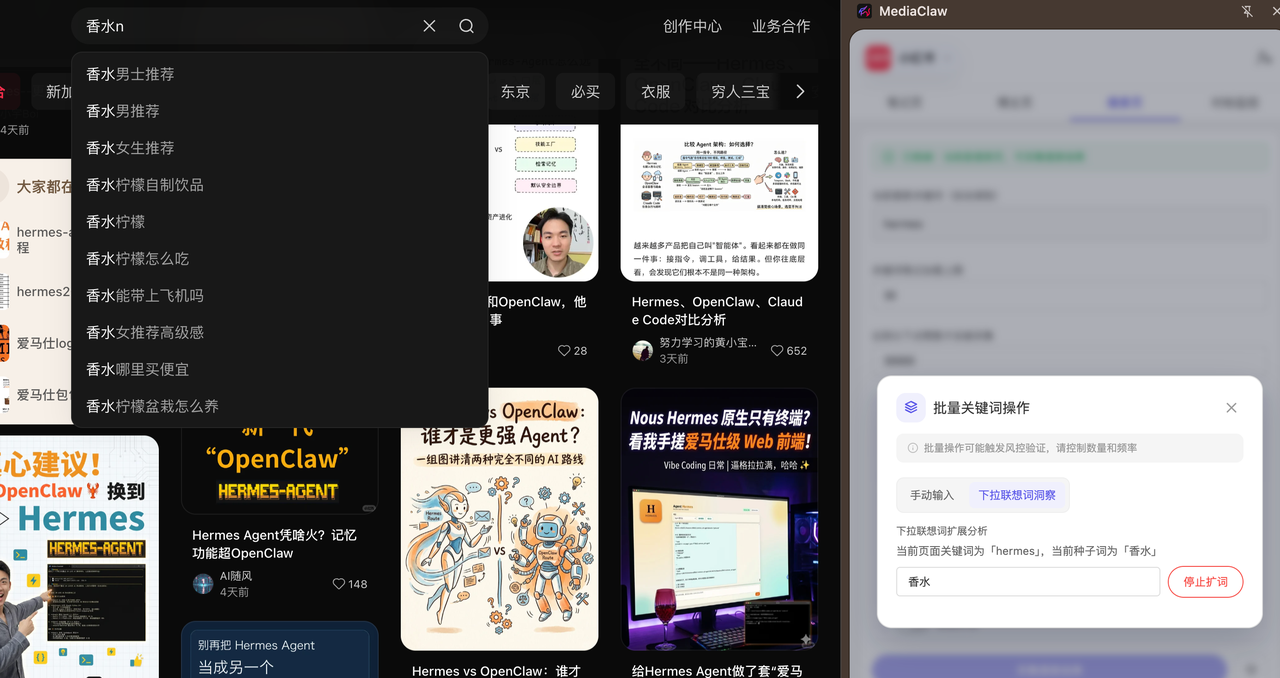
This entire workflow also works on Douyin (TikTok China) — MediaClaw's keyword insights feature is identical across both platforms.
If you're interested in how to use autocomplete expansion to find high-intent search traffic, check out this guide: How to Find High-Intent Search Traffic. Once you have your keyword list and want to build a systematic content calendar, this post walks through the full 5-step process: How to Build a Data-Driven Content Calendar in 5 Steps.
For New Xiaohongshu Creators, Direction Beats Consistency
Posting daily isn't worthless, but if you pick the wrong direction, 100 notes might generate less traction than 10 notes in the right direction. Do your niche analysis first — search one keyword, map the competitive landscape, find the angle that works for you — and then start creating. For new creators, this sequence is far more efficient.
Install MediaClaw, type in your niche keyword, and get a complete niche analysis report with content recommendations in 2 minutes.
FAQ
How do I choose the right content direction for a new Xiaohongshu (RedNote) account?
Search the main keyword for the niche you're planning to enter and look at the content distribution and organic reach potential in the niche report. Prioritize mid-tier directions with high organic reach potential, and avoid top-tier directions where the barrier to entry is extremely high.
As a content agency, how do I quickly assess the competitive landscape of an unfamiliar industry on Xiaohongshu?
Search the industry's main keyword and look at three metrics: upper-quartile average likes (the ceiling for top content), median likes (the baseline for average content), and the drop-off percentage between them. The larger the drop-off, the bigger the gap between top and average content.
Is there a tool that can analyze how competitive a specific keyword is on Xiaohongshu (RedNote)?
MediaClaw's keyword opportunity analysis does exactly this. Enter a keyword and it automatically generates a full report covering popularity, competition tiers, content direction breakdown, and topic recommendations for new accounts.


